Snow and Ice Contractor Insurance
Snow and ice work happens at night, in storms, on lots and walks that people cross the next morning. Your snow work, your trucks and the rest of your year each need coverage that fits. You see what each policy covers and what it leaves out, before the first storm.
Insurance for Plow Operators, Salting Crews and Ice Management Companies
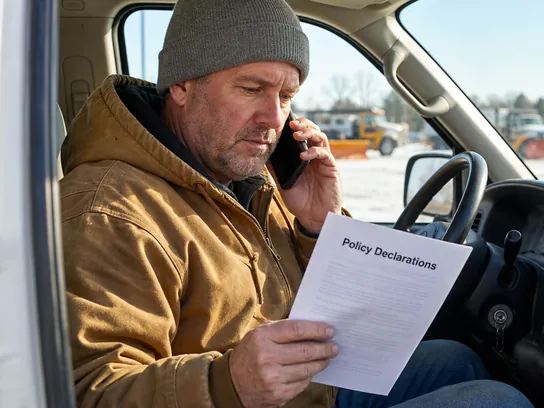
You might plow driveways with one truck, run plows and spreaders on commercial lots all night, or add snow work to a landscaping or contracting business for the winter. Each storm puts your trucks on the road in the worst conditions and your work under the feet of people who walk on it later.
General liability responds, in general, to claims brought by other people for bodily injury and property damage. Your customers’ contracts can also set what you carry and who must be named on your policy, so the contract and the policy belong side by side before you sign.
Snow and Ice Work We Insure
Tell us every service you sell in winter, and everything you do the rest of the year. These are a starting set.
- Residential plowing.
- Driveways and private roads on a route.
- Commercial lots.
- Retail, office and medical lots, often overnight.
- Salting, sanding and ice management.
- Treating lots, walks and steps before and after a storm.
- Sidewalk and walkway clearing.
- Shovels, blowers and small machines.
- Snow hauling and relocation.
- Moving piles off a site when there is no room left.
- Your year round work.
- Landscaping, contracting or property maintenance between storms.
Check that every season of your work is named on the policy.
Don’t see yours here? Tell us what you need covered.Snow and Ice Contractor Insurance Coverage
General Liability Insurance for Snow and Ice Contractors
A shopper slips on a patch of ice in a lot you salted, or your plow blade scrapes a customer’s curb and lawn. General liability pays damages your business is found liable for, up to the policy limits, plus the cost of your legal defense.
Completed Operations Coverage for Snow and Ice Contractors
A fall happens hours after your crew has left the lot. Completed operations coverage is for damage caused by your work after the work is done. Ask how your general liability policy treats a claim that comes after you finished the job.
Commercial Auto Insurance for Snow and Ice Contractors
Your plow truck slides through an intersection and hits a parked car. A personal auto policy will not cover a vehicle the business owns, and is unlikely to cover one used mainly for work. A business auto policy pays others for injury or damage you are liable for.
Workers’ Compensation Insurance for Snow and Ice Contractors
A shoveler slips on the steps they are clearing, or a driver is hurt hooking up a plow. Workers’ compensation pays for medical care and replaces part of lost wages, regardless of who was at fault. Most employers are required to carry it.
Tools and Equipment Coverage for Snow and Ice Contractors
Your plow blades, spreaders and snow blowers move from site to site all winter. Standard property insurance does not cover equipment that travels like that. A tools and equipment floater covers it wherever it is used. List each piece and what it is worth.
Commercial Property Insurance for Snow and Ice Contractors
Your shop, your salt shed and the equipment you store between storms can burn or be broken into. Commercial property insurance protects company property against losses such as fire, smoke, wind, hail and vandalism. It covers what stays put.
Umbrella Insurance for Snow and Ice Contractors
A serious fall on a busy lot, or a crash during a storm, can cost more than your limits. An umbrella policy sits over and above your general liability and auto policies and responds once their limits are used up.
Hired and Non Owned Auto Coverage for Snow and Ice Contractors
A crew member drives a personal pickup between walks with a blower in the bed. Hired and non owned auto coverage is the piece to ask about when vehicles the business does not own are used for its work.
Coverage Snow and Ice Contractors Can Be Missing
Gaps often show up in the middle of the season, when a customer asks for proof, a crew member gets hurt or a claim arrives from a lot you cleared weeks ago. A snow contractor can carry several policies and still have a hole between them, because each policy names what it covers and leaves the rest out. These are the places to look, and each one is a fair question to bring to your quote.
- The rest of your year.
- A policy that names only snow and ice work can leave your other work without liability coverage. Check what the policy names.
- The additional insured in your contract.
- A certificate does not make the holder an additional insured. The policy must have additional insured provisions or be endorsed.
- A waiver of subrogation.
- Subrogation is an insurer’s right, on your behalf, to sue a third party. If your contract waives it, the policy may need an endorsement.
- A hold harmless clause.
- It is a contract line in which one party takes on the liability of another. Send the contract before you sign, and each clause is read against your policy.
- A subcontractor’s certificate.
- A certificate is issued for information only and shows policies as of the day it was issued. Ask for a current one.
- What is earned, and when.
- If the policy is seasonal, the quote states what is earned and when.
If an Insurer Has Said No
That is one insurer’s answer, not the last one. Insurers have different underwriting standards, and a decision by one company does not mean another will not offer coverage.
State Facts
In Connecticut
- With few exceptions, every Connecticut employer must carry workers’ compensation insurance.
- A sole proprietor must accept the Workers’ Compensation Act to be treated as an employer for insurance purposes.
- Corporate officers, LLC members and partners may elect to be excluded from the Act.
- Out of state employers must cover their employees who work in Connecticut.
Read more: Workers’ Compensation in Connecticut.
Source: Connecticut Workers’ Compensation Commission.
Frequently Asked Questions
Does a policy that covers my plowing cover the rest of my work?
Only if it names the rest of your work. The wording lists what it covers and what it leaves out, and when you send it to us we read the two lists back to you.
A customer’s contract asks for a hold harmless clause. What am I agreeing to?
A hold harmless clause is a contract line in which one party takes on the liability of another. Send us the contract before you sign, and we will read each clause against your policy.
Can I use my personal auto policy for my plow truck?
A personal auto policy generally excludes business use, and it will not cover a vehicle the business owns. Commercial auto is the coverage to ask about.
Do I need workers’ compensation for a seasonal crew?
Most employers are required to carry workers’ compensation. Tell us how your winter crew is hired and paid. The state facts above describe how owners, members and partners are treated.
What if no company will write my general liability?
Contact us. Your file can go to the specialty market through licensed surplus lines brokers. No agency can promise a placement.
If a standard insurer says no, your policy may be placed this way, and it works a little differently. Some hard to place risks are insured by surplus lines carriers. These carriers are not licensed by the state as admitted insurers. Their policies can cost more, cover less or differently, and follow different cancellation and nonrenewal notice rules. They are generally not covered by the state insurance guaranty fund if the carrier fails. Surplus lines coverage is placed through a licensed surplus lines broker. We explain the differences to you in writing before you decide.
The quote asks for a large amount before the season. What should I ask?
Ask for the total premium, the down payment if one applies, and the payment schedule on one page. Ask for your payment terms in writing. See Premium Finance and Down Payments.
How do my past claims affect my quote?
Send your loss runs, and we will go through them with you. Loss frequency is how often claims are made on a policy during a premium period.
Tell Us About Your Whole Year, Not Only the Snow.
Your winter work and your year round work each need coverage that fits.